Feed on
Posts
Comments

autopano pro

i’ve discovered a new program for my mac this weekend that should make for a lot of fun w/ our summer backpacking pictures: autopano pro.   checkout what it did with 9 hand-held photos from bohol, philippines:

chocolate hills, bohol

server move complete!

my server has been down for the past couple of weeks as i completed my move back onto MIT’s campus.  now that the server is back online, i should hopefully be able to update this forlorn blog in the near future.  it’s been an eventful summer.

affirmation

‘been practicing my trackstand for months now whenever i ride my bike to the lab

initially, i’d treat drivers at intersections to morning real-life youtube blooper clips. as i tried to keep my balance and avoid taking my feet off the pedals when stopped at red lights, i’d wildly thrash around on my saddle like an epileptic being stung by bees, until — at the last moment — i’d yank my shoes out of my toe-clips with the agility of a spastic panda bear.  all in the name of one day, being able to execute a trackstand at an intersection and impress some pedestrian i didn’t even know was looking at me.

well, my friends, i’m proud to report that june 6th, 2008, is that day.

sometime last week, i realized i could finally pull off an indefinite trackstand.  and, on my way home this very evening, i was trackstanding at an intersection when a dude strolled by on the crosswalk and said, “hey!  that’s really cool!”  i knew that what he said carried special significance, because he was wearing sunglasses in the early evening and he therefore had to be cool himself.

my ego is going to trackstand in front of christina all night.

bliss

stata rain

it’s about 4pm on a tuesday and i’m ensconced in a glass atrium 5 stories about the street.  in front of me is a 60 foot high wall of glass, unbroken by frame or girder.  beyond that, a shrine to architecture is the horizon.

due to it now being summer vacation at MIT, and this atrium being behind a maze of locked doors and elevators, it’s just me in here.

i’m doing science on my laptop and there’s an epic thunderstorm going on about 3 inches of plate glass away.  i hope the lightning comes closer, since i can see so much sky out of these windows.  i crane my ahead all the way back to see drops of rain begin their long meandering journey down the plate glass and to my desk.

this is bliss.

i’ve only recently discovered: a) text messaging on my phone; b) t9 word completion.  i’m going to argue that i was born about 5 years too early for texting to be second-nature to me, the way using google comes so instinctively to my generation.

in any case, a texting feature i discovered on my phone today made me so happy.  i wanted to text the name of a restaurant to christina and i was in t9 mode.  i figured that since the restaurant’s name was an obscure proper noun (Montien), my plans would be dashed and i’d have to go back to the old hunt-and-repeatedly-peck of standard text messaging.  but as i hit the number encoding the last character in the restaurant name, “Montien” suddenly popped into my text message.

and then it hit me: all the names in my phone’s address book had automatically been added to my phone’s t9 dictionary.

i’m not quite sure why that discovery brought me so much geek joy.  perhaps it was the knowledge that enabling this feature would never be advertised; it would never lead to more phone sales.  i’d be surprised if the anonymous programmer (or his/her manager) even won any accolades in their design team for adding this feature.

no, it’s my belief that some anonymous soul at LG took it upon themselves to add that feature simply because it would make a better phone.  someone took pride in their technological creation.

kudos to you anonymous worker, for going out of your way to make my life just a little bit easier.

i got a little distracted lately and began designing our lab website.

i ended up getting a lot distracted; iweb is incredibly easy to use and making extremely visually appealing websites with very little effort is addictive.

if you’re interested in getting to see what happens when abercrombie & fitch meets a microbiology lab, check it out here.

i’m so excited — i’ve just walked out of the most enjoyable talk i’ve seen in my three years here at mit.  david macaulay, author of several architectural-themed books that i cherished as a child, just gave a one hour tour of how his imagination works over in the stata center.  there is no way i can even come close to capturing the excitement of his talk given the limitations of blogs and my storytelling capabilities.  instead, i thought i’d just note here some of the things i observed, in the hopes that these cues will help jog my memory for at least a couple years and thereby prolong the enjoyment i experienced tonight, past my recollection’s usual limit of about 3 days.

  • i gained a much deeper appreciation for the decision processes illustrators make.  macaulay kept asking himself: “how can i choose the viewpoint to a scene that will most strongly engage and involve the viewer?”  or, “am i conveying enough movement?”  he also constantly grappled with twisting perspectives: “how far can you bend straight lines so that the viewer sees everything that she needs to see to understand a composition?”
  • over the course of his whirlwind passage through at least 100 drawings and sketches, i grew more and more convinced that david macaulay cannot be human.  no man could possibly: a) possess an imagination that playful and rich; b) turn out such a prodigious amount of work in a single lifetime.  the detail in many of macaulay’s sketches is so meticulous that i’m convinced it would take me hours to simply trace, let alone conceive of one of his drawings.  (what’s perhaps even more astounding than what macaulay has published is what he hasn’t; so many of macaulay’s drawings that “weren’t good enough” or “weren’t quite right” would probably have been considered masterworks for normal illustrators.  it reminded me of the quotation attributed to gauss: “few, but ripe.”)  
  • it was breathtaking to be taken on a guided tour through the imagination of a certified creative genius.  to play witness to ideas’ first conceptions, to see how they’re folded and batted around, to watch them get crumpled up or occasionally refined and even finished.  all the while reflecting on macaulay’s punctuated, but still quite funny and witty narration. 

ok, it’s time for dinner — enough hero worship for now.  final words for future lawrence: “don’t forget this lecture!  this was one of the reasons why you spent 5 years of your life living in the second-lowest tax bracket.”   oh, and a little something to jog future lawrence’s very visual-based memory:   macaulay talk at mit (i’m just blown away by how decent the camera is on my phone.  although future lawrence probably won’t be as much.)

in passing

arthur c. clarke passed on today.  i just read his obituary and learned that he was the original author of the aphorism:

“Any sufficiently advanced technology is indistinguishable from magic.”

the next time i try and explain microbial evolution to someone, i think i’m going to quote mr. clarke.

danielle

auntie danielle, my sister’s godmother and my mother’s best friend passed away last night.  i thought i’d leave a photo here of danielle that i took on our way to the philippines two years ago.

auntie danielle

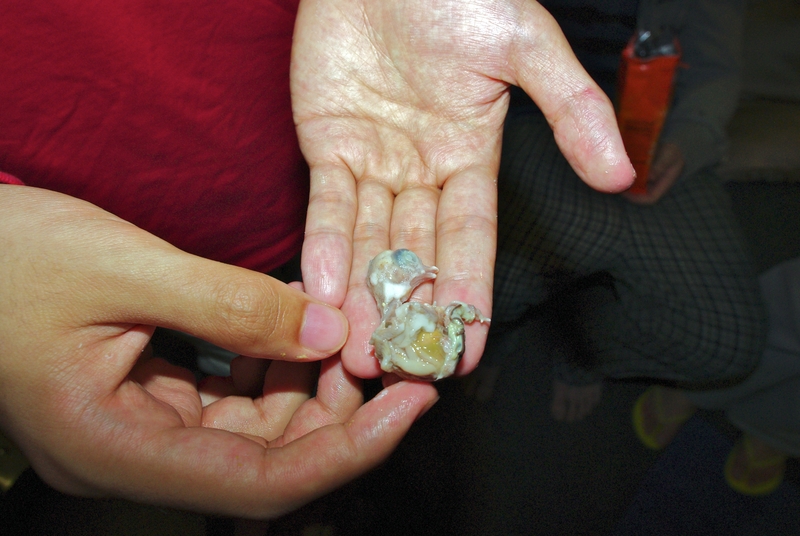
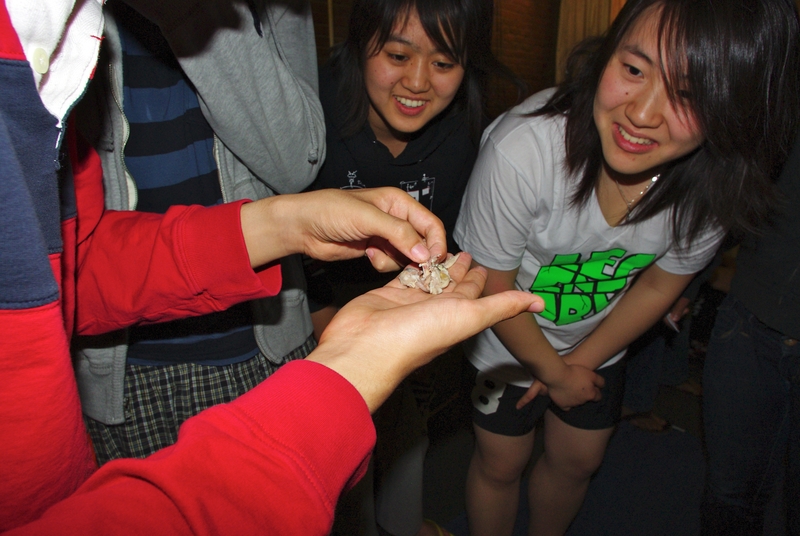
meet hubert, my octopus.  he came to visit last week while i waited for some particularly long modeling jobs to execute on the darwin computing cluster (more on that later).

hubert’s timing couldn’t have been better, as his visit coincided with ned ruby’s to mit.    here’s a picture of ned:

ned is a microbiologist from wisconsin who studies the symbiosis between the doe-eyed 3cm-long cephalopods above and a bacterium named vibrio fischeri.  the talk ned gave on that symbiosis was fascinating — it was filled with precisely the kinds of wondrous stories and unbelievable facts about the natural world that convince naive students to forego the median tax bracket and become phd candidates.

he began, as microbiology talks often do, by explaining why folks shold care about microbes.  in particular, he highlighted the applications of studying microbial symbioses.  to paraphrase:

there are roughly 10 bacterial cells in the human body for every 1 human cell.  folks estimate that each person harbors around 25,000 unique bacterial species.  the human genome consists of roughly 20,000 genes; the microbial pan-genome within us consists of approximately 3,000,000.

this begs the questions: how are 3,000,000 genes simultaneously regulated in the human body?  how are millions of unique metabolites and enzymes produced, transported, and employed in any coherent way?

tackling a symbiosis problem on that scale would be like trying to build a model of how individual cars affect the american nation.  so, ned decided to simplify the problem.  the squid he studies, euprymna scolopes (they look remarkably like ned above), enjoy the unique ability to selectively screen which bacterial species colonize certain regions of its body.  specifically, the squid possesses an organ on its belly that only vibrio fischeri can live in.

and here’s where things get amazing.  it turns out that the squid are nocturnal and feed near the ocean’s surface.  this makes them easy prey; predators in deeper waters can easily find the squid by looking upwards and pouncing on the shadows in the moonlight.  in response, the euprymna have evolved an ingenious trait known as counter-illumination.  while they swim at night, the euprymna’s vibrio-filled organ glows, thereby camouflaging their shadows in the moonlight.  by manipulating various muscles in the light organ that act as lenses, shutters, and filters, the squid can even control the intensity and dispersion of its anti-shadow.

how and why the vibrio bioluminesce is its own fascinating question in of itself that has already bestowed doctorates and macarthur fellowships on several researchers.

what ned talked about was studying how the euprymna and vibrio have evolved to interact with one another.  now, it took him an hour to explain what he’s learned over the past decade and i haven’t got the blogging fortitude to transcribe thirty slides worth of information.  besides, my memory has got the fidelity of a game of telephone.  so here’s the most salient points from the presentation:

  • the euprymna are actually born aseptic.  within hours of being born, however, a handful of vibrio fischeri will colonize the light organ.
  • over the course of the day, the vibrio make like calculators and rapidly multiply, eventually filling the light organ to capacity.
  • after the evening feeding session, the euprymna contract the muscle surrounding the light organ and expel virtually all of the vibrio.

“huh?” i thought, as i heard that last bullet.  why kick out beneficial bacteria?

no one’s totally certain, but a leading hypothesis is that the bacteria are actually driving the expulsion!  the vibrio, perhaps not unlike pathogenic strains of e. coli, release toxins that likely degrade the membranes of the light organ, ultimately compelling the euprymna to eject the vibrio.  and by getting the heave-ho, millions of vibrio are re-introduced into the water column, ready to populate new infant euprymna.

this ending to the fairy tale blew me away.  on the one hand, you’ve got a bug that’s basically like cholera: it desperately wants to spread and effects that transmission by irritating mucosal membranes until the point of host expulsion.  but, unlike human-affecting cholera, these vibrio are profoundly beneficial to their host in some ways, thereby providing enough incentive for the euprymna to not evolve a comprehensive mechanism for complete vibrio fischeri clearance.  just a wicked cool example of how an apparently mutually beneficial symbiosis in nature can actually be a struggle between two completely opposing forces.

oh and two sidenotes:

  1.  ned ruby raises something like 10^5 euprymna a year in aquaria in his lab.  i was dying to ask him how they tasted.
  2. in case you were wondering, poor hubert the hand-octopus was indeed sick with smallpox.  he passed  only a day after his photo was taken.

Next »